On Peptide Pureness
@jeffreyygps142
Peptide Purity & Quantitation Testing Identification confirmation confirms the certain secretagogue being studied. Peptides like BPC-157 and TB-500 utilized for injury recovery applications must get complete verification. Identification verification is essential because alternative with different compounds would essentially change the research study technique. The testing process entails specific steps to guarantee accurate results and appropriate sample handling. For these high-stakes situations, the expense of screening is trivial contrasted to possible repercussions of using unverified items. For scientists following methods from resources like the BPC-157 and TB-500 piling guide, validated item quality makes sure the method obtains a reasonable assessment. Peptides and their impurities have different hydrophobicities and consequently spend different amounts of time connecting with the C18 stationary stage before eluting into the detector. More hydrophilic substances elute early (reduced retention time); even more hydrophobic compounds elute later (high retention time). The target peptide elutes at a characteristic retention time, and contaminations elute at various times-- dividing them spatially on the chromatogram. In the typical peptide COA context, height purity generally refers to the percentage of complete chromatogram area represented by the major peptide top. It is an area-percent purity measurement, not a total identity or activity examination. Peptide screening is powerful, however researchers need to review the extent of each approach carefully. Peptide pureness isn't just a number on a tag-- it's a window right into the top quality of the synthetic process and a predictor of exactly how reputable your study outcomes will be. During solid-phase synthesis, each amino acid combining step has a yield of roughly 99-- 99.8%. When a combining falls short, the expanding chain is capped to stop more elongation of the inaccurate series. The result is a peptide that's much shorter than planned-- missing one or more amino acids. Customized guidance for individual researchers seeking reliable peptide vendors.
Authenticity Confirmation
Imaginative Proteomics supplies peptide purity analysis using logical reversed-phase HPLC combined with mass spectrometry. They offer MALDI-TOF MS and various other mass spectrometry alternatives routinely. Mass spectrometry (MS) verifies peptide identification by measuring molecular weight. The method identifies the specific mass of the peptide, which functions as a molecular finger print. If the measured mass matches the expected mass for your peptide series, you have confirmation that the appropriate compound is present. And the only means to know what you're actually obtaining is through proper analytical screening. These pieces are typically smaller than the target peptide and may elute at different retention times. HPLC can show the existence of extra heights; LC-MS can aid designate most likely identities to those associated species. Amino acid evaluation or other measurable approaches can sustain outright material. Chiral methods can address enantiomeric pureness where stereochemistry is an issue. Residual-solvent or water-content tests can matter in production or stability contexts. These are beneficial in the best setting, yet they should be taken method-specific proof instead than an universal substitute for HPLC and MS.Endotoxin Screening:
Where can I send my peptides to test for pureness?
ACS https://riverixzg745.alderbrief.com/posts/what-are-peptides-why-your-body-isn-t-healing-and-clinical-following-actions-ubie-doctor-s-note Peptide Testing Labs is a specialist peptide analysis laboratory that approves samples from all 50 states. Whether you need to examine peptide pureness, validate a distributor''s Certification of Evaluation, or run comprehensive impurity testing, our lab supplies quick, exact results with detailed coverage.
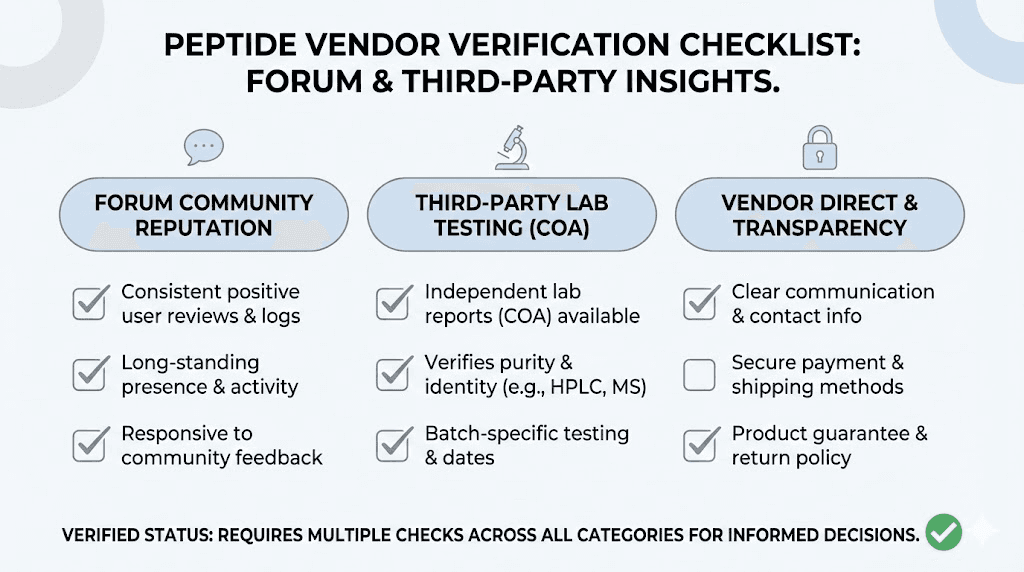
- HPLC can show the visibility of additional tops; LC-MS can assist assign likely identifications to those associated species.
- For exploratory testing assays where rough task information is sufficient, 95% purity might serve.
- HPLC is among the most generally used methods in peptide purity testing.
- Determining peptide pureness is normally finished with analytical high-performance fluid chromatography (HPLC), often combined with mass spectrometry (MS) for identification confirmation.

◇